

No products in the cart.
Tabriz Distillation – Farvardin 1403
In the heart of one of the largest fatty acid production units in northwestern Iran—Tabriz Distillation Plant, located in the West Tabriz Industrial Zone—a critical and strategic project was successfully completed in the spring of 1403: the full automation of the autoclave section in the hydrolysis unit. This unit serves as the backbone for producing industrial fatty acids used in detergents, cosmetics, paints, and even animal feed additives. It processes hundreds of tons of crude oil (palm, soybean, or animal-based) daily into crude fatty acid and valuable glycerin water. However, this high-pressure chemical process is as delicate as walking a tightrope: a mere 2°C deviation in temperature or 0.5 bar in pressure can reduce efficiency from 98% to below 85%, or even lead to unwanted decomposition and toxic byproducts.
In this project, leveraging intelligent Omron controllers and precise automation of critical variables transformed this precarious balance into a safe and smooth pathway—where accuracy, safety, and stability are no longer aspirations but daily operational realities.
Process Overview and Challenges
The hydrolysis process, rooted in the splitting of fats, has been industrial since the 1930s. In Iran, given the abundance of imported and domestic oils, it is a key value-adding chain. In this stage, crude oil reacts in horizontal or vertical autoclaves for 1–3 hours under high pressure (40–60 bar), high temperature (240–260°C), and in the presence of superheated steam. The result? Triglycerides break down into free fatty acids (e.g., palmitic acid C16:0, oleic acid C18:1) and glycerin—a valuable raw material for pharmaceutical and food industries.
The main challenges lie in controlling three critical variables:
Advanced Sensor Technology
At Tabriz Distillation, these variables were measured with state-of-the-art industrial sensors:
– Temperature: Type K thermocouples with 2-wire transmitters (±0.5°C accuracy).
– Pressure: Omron E8FC absolute and differential pressure transmitters (0.1% FS accuracy, 0–100 bar range).
– Level: Non-contact radar level transmitters (Vega/Rosemount, ±1 mm accuracy, resistant to steam and foam).
Data from these sensors were transmitted via analog (4–20 mA) or digital (HART/IO-Link) signals to Omron NX/NJ series controllers—the core of the system.
Intelligent Control with Omron: Modular, Fast, and Secure
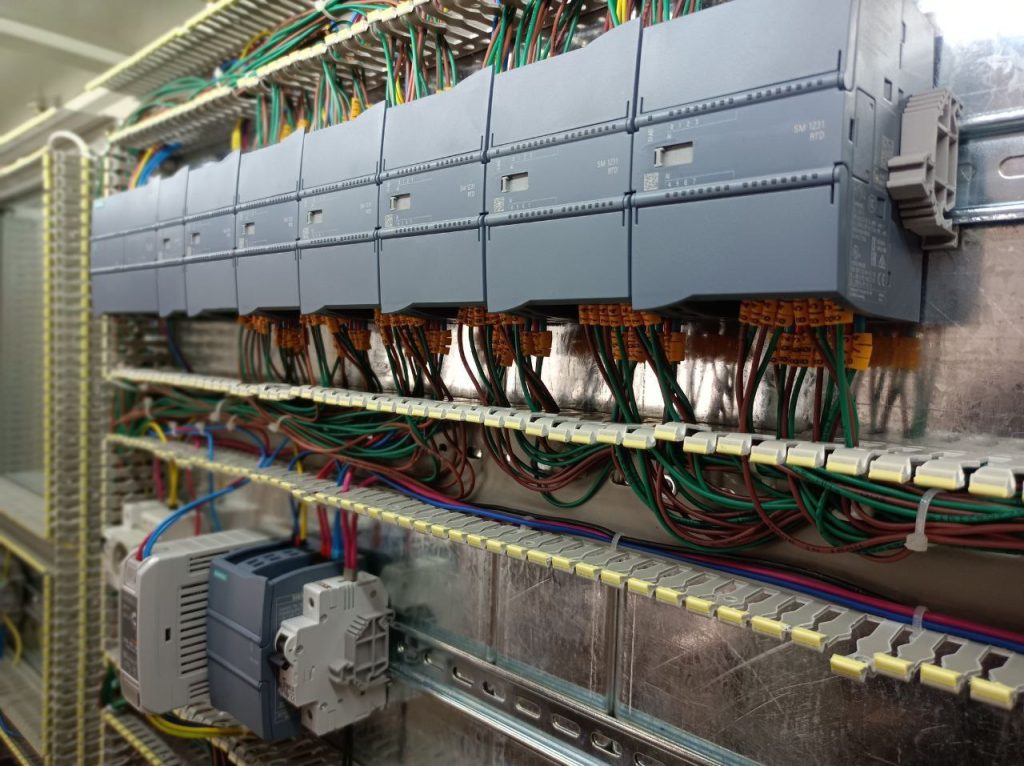
Unlike legacy systems reliant on timers and mechanical pressure relief, this project utilized modular Omron NX1P2 controllers—a compact PLC with 0.1 ms processing speed, 32k step memory, and expandability up to 64 I/O modules. This multi-tasking “brain” simultaneously:
– Executes advanced PID algorithms for each variable,
– Monitors safety logic with NX-SL modules,
– Reduces reaction time to 1 millisecond.
For example, in Autoclave No. 2:
– Temperature setpoint: 255°C,
– PID parameters: Kp = 1.2, Ki = 0.08, Kd = 15 (tuned via Ziegler-Nichols method),
– PID output → Pneumatic steam control valve with intelligent positioner.
If temperature deviates by more than 3°C from the setpoint, a critical alarm activates, and the emergency vent valve opens automatically—without human intervention.
Precision Fluid Flow Control
A standout achievement of this project was the precise control of fluid flow in the autoclave’s input and output paths:
– Crude oil flow: Electromagnetic flowmeters,
– Steam flow: Vortex flowmeters,
– Crude fatty acid output: Coriolis flowmeters (0.1% accuracy).
Data from these devices were sent to pneumatic control valves equipped with Omron E5CC digital positioners. These valves, with 0.5% accuracy, operated like a pianist’s fingers:
– Crude oil input: 5 tons/hour,
– Steam input: 1.2 tons/hour,
– Molar water-to-oil ratio: 1.5:1 (optimized for maximum efficiency).
Omron’s control algorithms, using PID and Ratio Control function blocks, dynamically maintained this ratio—even with viscosity changes due to temperature fluctuations. The result? Process stability within ±0.2%, even during 24-hour shifts.
Stability, Safety, and a Smart Future
This project brought structural transformation to the hydrolysis unit:
– Enhanced accuracy: Temperature deviation reduced from ±5°C to ±0.8°C, pressure from ±3 bar to ±0.3 bar.
– Reduced human error: 90% elimination of manual adjustments.
– Improved stability: Flash tank fluctuations reduced from 15% to under 2%.
– Operational safety: Automatic safety interlocks (e.g., pressure >65 bar → steam shutdown + emergency venting).
Furthermore, EtherCAT communication modules enabled integration with the plant’s central SCADA and MES systems—a step toward Industry 4.0 in Tabriz. Process data, archived at 1-second intervals in an SQL database, now support predictive analytics (e.g., catalyst replacement scheduling).
Results and Impact
This project not only increased hydrolysis efficiency to 98.5% but also reduced energy consumption by 18% and unplanned downtime by 85%. Tabriz Distillation has now become a benchmark for other oleochemical units in Iran—where Japanese precision (Omron) meets Iranian engineering, creating a world-class product. This is not just a project—it is the future of smart fatty acid production in Iran.